Category Archives: Economics

Halloween Food Statistics

Another holiday is upon us, which means that the U.S. Census has compiled another set of statistics. The observance of Halloween, which dates back to Celtic rituals, has long been associated with images of witches, ghosts and vampires. There are also foods related to Halloween; below are a few highlights from the Census findings.

1.1 billion pounds
Pumpkin production by major pumpkin-producing states in 2010. Illinois produced an estimated 427 million pounds of the vined orange gourd. California, New York and Ohio were also major pumpkin-producing states, each with an estimate of more than 100 million pounds.
Source: USDA National Agricultural Statistics Service

1,177
Number of U.S. manufacturing establishments that produced chocolate and cocoa products in 2009, employing 34,252 people. California led the nation in the number of chocolate and cocoa manufacturing establishments, with 135, followed by Pennsylvania, with 111.
Source: U.S. Census Bureau, County Business Patterns: 2009, NAICS codes(31132 & 31133)

409
Number of U.S. establishments that manufactured non chocolate confectionary products in 2009. These establishments employed 16,974 people. California led the nation in this category, with 45 establishments.
Source: U.S. Census Bureau, County Business Patterns: 2009, NAICS code (31134)

24.7 pounds
Per capita consumption of candy by Americans in 2010.
Source: U.S. Census Bureau, Current Industrial Reports, Confectionery: 2010, Table 1
Nuts About Fudge Brownies and Walnut Statistics

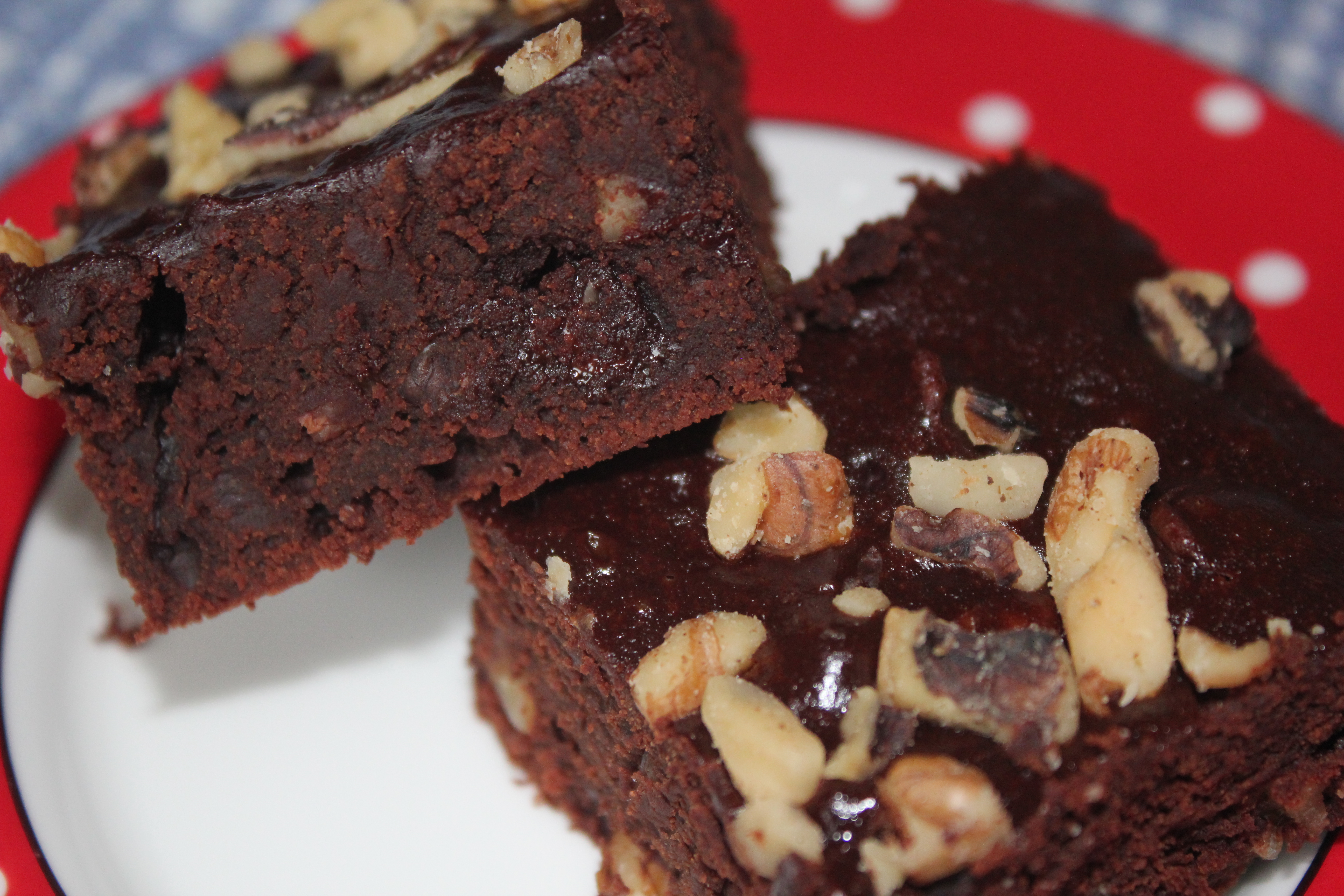
I could not resist baking these fudgy brownies that I found in the September 2011 issue of Cooking Light. Could I change the recipe so it did not have sugar but still had that fudge quality? I was willing to give it a try.

Walnuts, of the tree nut family, are optional in this recipe. According to the George Mateljan Foundation, walnuts are a great source of antioxidants and anti-inflammatory nutrients. Almost 40% of the world’s walnuts are grown in the U.S., mostly in California. The U.S. Department of Agriculture estimates that 485,000 tons of walnuts will be harvested in California in 2011, down 4% from the previous year. The crop is supposed to be of high quality because of the mild temperatures during the growing season. The price per ton of the harvested walnuts is not yet confirmed for 2011 although last year’s price of $2,110 per ton was the second highest price in the past 20 years. During those 20 years, the highest price per ton was $2,290 in 2007, and the lowest price was $886 in 1999.

All of this talk about walnuts is leading me to think about these delicious brownies…and my successful attempt at creating this dessert without refined sugar. Hooray! Enjoy the dessert!

Refined-Sugar Free Walnut Fudge Brownies

Ingredients
3/4 cup all-purpose flour
2/3 cup agave nectar
3/4 cup cocoa powder
1/4 cup honey
1/2 teaspoon baking powder
1/4 teaspoon salt
3/4 cup grain-sweetened chocolate chips
1/3 cup fat-free milk
6 tablespoons butter, melted
1 teaspoon vanilla extract
2 large eggs, lightly beaten
1/2 cup chopped walnuts, divided

Preparation
1. Preheat oven to 350°.
2. Combine flour and next 5 ingredients (through salt) in a large bowl. Combine 1/2 cup chocolate and milk in a small saucepan; melt chips on low heat, stirring occasionally. Stir in butter, vanilla, and eggs. Add milk mixture, 1/4 cup chocolate, and 1/4 cup nuts to flour mixture; stir to combine.
3. Pour the batter into a 9-inch square metal baking pan coated with cooking spray; sprinkle with remaining 1/4 cup nuts. Bake at 350° for 19 minutes or until a wooden pick inserted in center comes out with moist crumbs clinging. Cool in the pan on a rack. Cut into squares.

I am sharing this recipe with Joy of Desserts, Simply Sugar and Gluten Free, Beauty and Bedlam, Lady Behind the Curtain, This Chick Cooks, Miz Helen’s Country Cottage, Food Trip Friday, Sweet as Sugar Cookies and Something Swanky.

Quick! Make These Peanut Butter Chocolate Chip Cookies Before Prices Increase!

According to the Chicago Sun-Times, the prices for peanuts and peanut butter are on the rise. The peanut supply is lower than normal due to two factors: (1) fewer peanuts were planted because farmers opted to grow more profitable cotton and corn, and (2) the prolonged high temperatures this summer adversely affected the peanut crop.

Alabama, Florida, Georgia, Mississippi, New Mexico, North Carolina, South Carolina, Texas and Virginia produce the majority of the nation’s peanuts. According to the USDA, an extreme drought in Texas and Oklahoma has reduced the peanuts harvested.

J.M. Smuckers, which makes JIF, has announced that the price of its peanut butter will increase 30% starting in November. Other peanut companies are likely to follow suit.

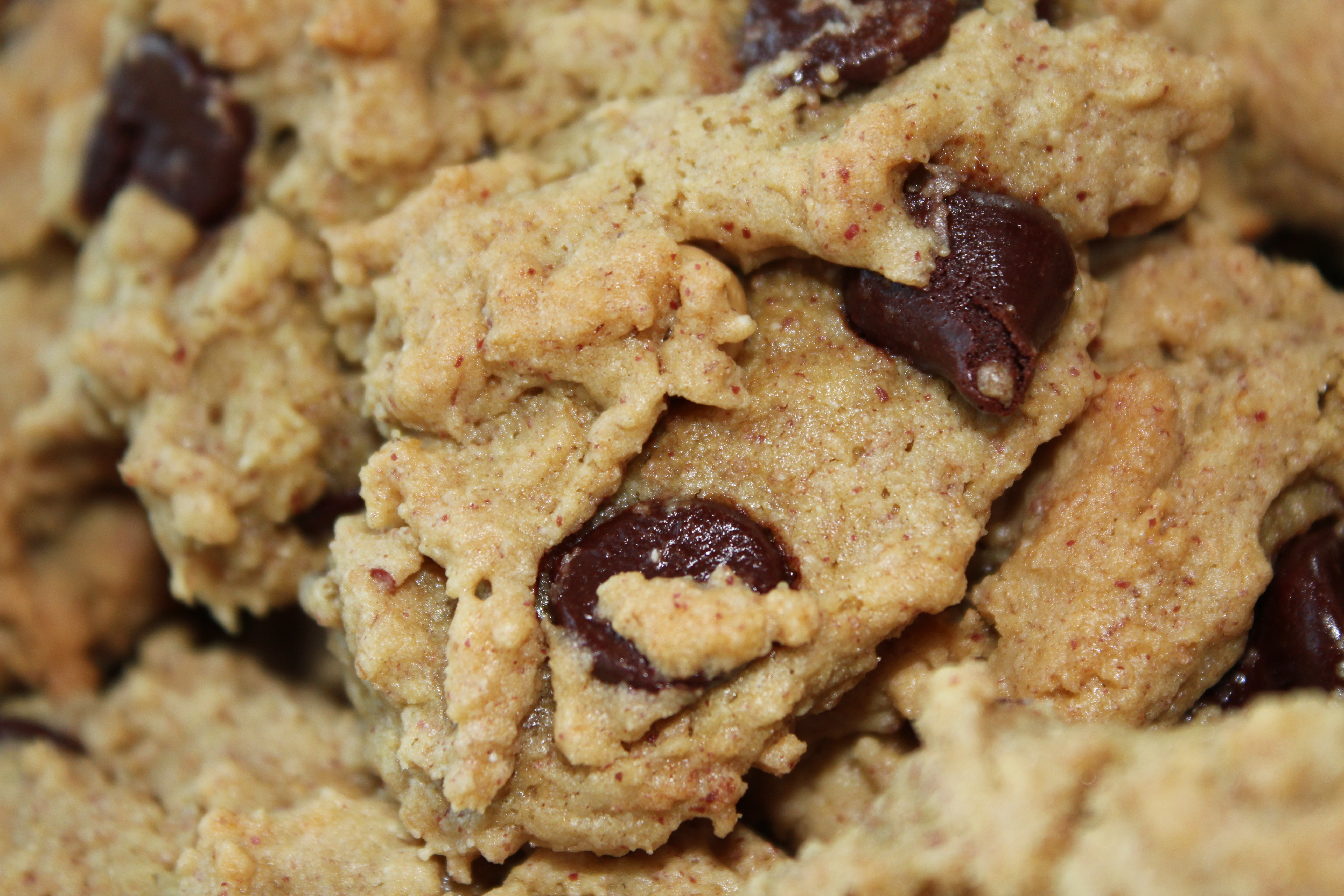
So what should we do? I say let’s bake, bake, bake…and fast before the prices rise. There are lots of peanut butter foods from which to choose – I have already shared recipes for Peanut Butter Cups, Honey Peanut Butter Frosting and Peanut Butter Chocolate Chip Brownies, and now I am happy to share a terrific recipe for Peanut Butter Chocolate Chip Cookies below. The recipe was inspired by Terry Walters’ Clean Food; I used whole wheat flour instead of teff and swapped grain-sweetened for semisweet chocolate chips. I plan on enjoying these delicious cookies often…and stocking up on peanut butter this month so I can keep baking them through the winter.

Ingredients:
1-1/2 cups whole wheat flour
1/4 teaspoon sea salt
1 teaspoon baking soda
1 cup chunky 100% organic peanut butter
1 cup maple syrup
1/2 cup grain-sweetened chocolate chips

Directions:
Preheat oven to 350°F.

Combine all dry ingredients in one bowl and all wet ingredients in another. Pour wet ingredients over dry and blend until just combined – do not overmix. Fold in chocolate chips.

Drop batter by heaping teaspoons onto cookie sheet. Place in oven and bake 13 minutes or until lightly browned. Remove from oven and place directly on wire rack to cool. Makes approximately 20 cookies.

I am sharing this recipe with Joy of Desserts, Simply Sugar and Gluten Free, Balancing Beauty and Bedlam, Lady Behind the Curtain, This Chick Cooks, Miz Helen’s Country Cottage, Food Trip Friday and Sweet as Sugar Cookies.

A Flavor and Cost Review of Whole Grains

Since I made the maple raisin scones using millet flour, I have been interested in learning more about whole grains. Since my use of millet flour was such a success, what other whole grains could I use?

Grains are the seeds of certain plants. Inside the seed is the germ, and attached to the germ is a starch called the endosperm. Both are protected inside the bran that surrounds them. When grains are refined, the bran and germ are stripped away, leaving the starchy part that is less nutritious. When in the grocery store, look for labels that list whole wheat flour, whole oats, or other whole grains. Wheat flour is not a whole grain.

The following chart is adapted from the Whole Foods Market Magazine, North Atlantic Region, Spring 2011. The chart lists all of the whole grains along with their characteristics and other intereting food facts.

The economist in me also decided to do a cost comparison among the whole grains. So I searched for each whole grain on Amazon, and chose the first one listed to create a relative whole grain price index. I divided the price per ounce for each of the whole grains. It is interesting to note that the spread among the prices for the whole grains is not too large, although rye is the least expensive and quinoa is the most expensive. Compared to alternative sweeteners, whole grains are a relatively good deal!

If you are willing to buy in bulk, Whole Foods Market allows customers to special order bulk items in “case” quantities to receive a 10% discount off regular bulk retail price. It’s another way to keep your grocery bills on a budget.

I now have my sights on some other whole grains to try…which do you plan to try, or which ones do you already use?

Steak and Statistics

Did you know that the first observance of Labor Day is believed to have been a parade of 10,000 workers on September 5, 1882, in New York City, organized by Peter J. McGuire, a Carpenters and Joiners Union secretary? By 1893, more than half the states were observing “Labor Day,” and Congress passed a bill to establish a federal holiday in 1894. President Grover Cleveland signed the bill soon afterward, designating the first Monday in September as Labor Day. Thanks to the U.S. Census for this information and the statistics that follow.

How are you celebrating this holiday? I have had the opportunity to go shopping to take advantage of some fabulous sales, along with visiting family and friends I haven’t seen in awhile. I had a “Wicked” good time seeing that musical too! And what’s on the menu for dinner tonight? Grilled steak! It is such an appropriate Labor Day entree, don’t you think? Enjoy the following statistics and your Labor Day.

153.2 million
Number of people 16 and older in the nation’s labor force in July 2011.

84.7%
Percentage of full-time workers 18 to 64 covered by health insurance during all or part of 2009.

Americans work in various occupations. Below is a sample:
Teachers (preschool – grade 12): 3,039,523
Computer Operators: 101,889
Actors: 10,980
Telephone Operators: 32,394
Bus Drivers: 265,429
Bakers: 117,405
Telemarketers: 55,733
Hairdressers, hairstylists and cosmetologists: 395,503
Janitors and building cleaners: 1,478,204

26.2 million
Number of female workers 16 and older in management, professional and related occupations. Among male workers, 16 and older, 24.0 million were employed in management, professional and related occupations.

53%
Projected percentage growth from 2008 to 2018 in the number of network systems and data communication analysts. Forecasters expect this occupation to grow at a faster rate than any other. Meanwhile, the occupation expected to add more positions over this period than any other is registered nurses (581,500).

76.1%
Percentage of workers who drive alone to work. Another 10.0 percent carpool and 5.0 percent take public transportation (excluding taxicabs).

25.1 minutes
The average time it takes people in the nation to commute to work. New York and Maryland had the most time-consuming commutes, averaging 31.4 and 31.3 minutes.

3.2 million
Number of workers who face extreme commutes to work of 90 or more minutes each day.

The Blueberry Industry and Crumb Bars

Did you know that the U.S. leads the world in blueberry production, at almost 200,000 metric tons in 2008? North America certainly dominates this market since the next largest producer is Canada with almost 95,000 metric tons. Poland is distantly in third place with almost 8,000 metric tons.

The states that cultivate the most blueberries are Maine and Michigan with the Great Lakes State slightly edging out the Pine Tree State. Maine’s lead is in the wild blueberry market; virtually all of Maine’s cultivated blueberries are processed while about half of Michigan’s are used fresh and the other half processed.

The acres of land harvested for blueberries has about tripled between 1980 and 2009. The grower price for fresh blueberries has doubled during the last fifteen years while the price for processed has plummeted. Perhaps this is evidence of the increased demand for these sweet and healthy little fresh gems of goodness?

For those of you who would like to learn more about the blueberry industry, the USDA has a great web site with lots of interesting data like the facts above. If however, all of this talk about blueberries has you ready to eat some, below is a fabulous recipe for crumb bars that I adapted to make refined-sugar free. It’s a great time of year to use blueberries! And if you still have a few fruits left over, might I suggest making some blueberry oat bran muffins as well. Happy native blueberry season!

Blueberry Crumb Bars

2/3 cup agave nectar
1 teaspoon baking powder
2 cups all-purpose flour
1 cup whole wheat flour
3/4 cup canola oil
1 egg
1/4 teaspoon salt (optional)
1 pinch ground cinnamon (optional)
4 cups fresh blueberries
1/3 cup agave nectar
3 teaspoons cornstarch
1 teaspoon maple sugar (optional)

Preheat the oven to 375 degrees F. Grease a 9×13 inch pan.

In a medium bowl, stir together 2/3 cup agave nectar, both flours, and baking powder. Mix in salt and cinnamon, if desired. Mix in the oil and egg. Dough will be slightly crumbly. Pat half of dough into the prepared pan.

In another bowl, stir together the agave nectar and cornstarch. Gently mix in the blueberries. Sprinkle the blueberry mixture evenly over the crust. Crumble remaining dough over the berry layer. Sprinkle with maple sugar, if desired.

Bake for 40 minutes or until top is slightly brown. Cool completely before cutting into squares (about 16).

Adapted from Jam Hands and AllRecipes.

I am also sharing this recipe with Joy of Desserts, Simply Sugar and Gluten Free, Beauty and Bedlam, Tempt my Tummy Tuesdays, Lady Behind the Curtain, Miz Helen’s Country Cottage, Something Swanky, Food Trip Friday and Sweet as Sugar Cookies.

The Economy is No Peach, But This Ice Cream Sure Is!

My alternate title for this blog post was: “Tired of waiting for QE3*? This peach ice cream will ease your mind!” What a week to be an economist with food sensitivities – there is certainly no shortage of reading material!

At our most recent picnic celebrating family togetherness and my sister-in-law’s birthday, my MIL created a delicious homemade peach ice cream. In her first batch she used regular sugar as the sweetener, and in the second batch she used honey. They were enjoyed greatly, and those who tried both did not notice a difference in taste. Now that’s a positive indicator!

MIL’s Homemade Peach Ice Cream (Adapted from Joy of Cooking)
4 ripe yellow peaches (or 2 pounds)
1/2 cup honey
1 1/2 cups whipping cream
1/2 cup skim milk
1 teaspoon vanilla

Bring a large pot of water to a boil.  Lower in peaches and poach for 1 minute. Remove and slip skins off under cool running water. Discard pit and put peaches into blender.

Blend peaches with half of the honey. Swirl until smooth, 1-2 minutes.  Chill an hour or more.

Mix in separate bowl: cream, milk, remaining honey and vanilla.  Chill an hour or more.

Churn:  Give cream mixture a good stir.  Pour into an ice cream maker and churn until thick (about 15-20 minutes).  
When almost frozen, pour in peach mixture and churn again until thick.  Enjoy immediately, OR pack into an air tight
container and freeze.  Let warm 10 minutes at room temperature before scooping.  Best if used within two weeks.

As shown in the photo, the sugary and sugar-free versions of this delicious ice cream look quite similar.

*QE3 refers to the potential third round of quantitative easing by the U.S. Federal Reserve. It is an economic stimulus approach by which a central bank purchases bond assets, either government or private sector, in order to depress medium to long term interest rates and to encourage investors to spur the economy by putting their money elsewhere.

I am also sharing this recipe with Simply Sugar and Gluten Free, Something Swanky, Joy of Desserts, Two Maids a Milking, Beauty and Bedlam, This Chick Cooks, The Lady Behind the Curtain, Food Trip Friday and Sweet as Sugar Cookies.

Industries Take Action to Offer Healthier Meals

The past few days have brought news from the fast food and packaged food industries, highlighting actions to increase healthy food options for children.

First, the National Restaurant Association announced The Kids Live Well initiative. More than 15,000 restaurants representing 19 chains have already signed on, with more expected to join in the coming months. For a list of participating restaurants, click here. Participants in the initiative are expected to:
–Offer at least one children’s meal (entrée, side, beverage) that is 600 calories or less; containing two or more servings of fruit, vegetables, whole grains, lean protein and/or low-fat dairy; and limiting sodium, fat and sugar;
–Offer at least one other individual item that has 200 calories or less with limits on fat, sugar and sodium, and contains a serving of fruit, vegetables, whole grains, lean protein or low-fat dairy;
–Display or make available the nutrition profile of the healthful menu options; and
–Promote the healthful menu options.

In addition, to avoid federal regulation being imposed, some of the nation’s largest food and beverage companies including Kraft, Kellogg, Nestle, Coca-Cola and PepsiCo have come together through self-regulation to restrict the kinds of products they advertise and market toward children. A number of food types including juices, dairy products, grains, soups and meals will have limits on the amount of calories, sugar, sodium and saturated fat allowed in foods promoted to children. As it stands, the recipes of about one-third of all food beverages would have to change or the companies will not be able to advertise those products after December 31, 2013.

These recent actions by the fast food and food products industries are positive steps to offer healthier options for customers.

Julia Child, as Always an Inspiration

I decided to take a break from my usual novel to delve into a collection of letters written during the 1950s and 1960s by the wife of a popular journalist and a woman who had completed studies at Le Cordon Bleu in Paris and was writing a cookbook.

In As Always, Julia, Bernard DeVoto penned an article about American knives for Harper’s, and Julia extended her support for his findings by mailing him a letter along with one of her favorite chopping utensils. His wife Avis first responded to the letter, which marked the beginning of their friendship that would last decades.

The two wrote back and forth fairly regularly even though the Childs moved quite often – to France, Germany and Norway. Once the DeVotos and Childs met while Julia and Paul were in the U.S., the friendship was solidified as evidenced in the increased depth of emotions described in the writings.

It is fascinating to read, in this collection of letters, the range of topics covered including food, no doubt, and also the struggles of obtaining a publishing contact, opinions on the political climate in the U.S. and abroad, details about parties and fashion, trying and retrying recipes, and the ups and downs of family events. I was inspired in my own cooking trials to know that even Julia Child tried recipes over and over again before getting them just right.

The economics of book publishing was discussed at length. Houghton Mifflin, the first company to discuss a possible contract, eventually turned Julia and her collaborators down because they could not make a business case for publishing a how-to guide for French cooking. However Knopf, the company that eventually gave Julia a contract, thought there was a market for such a book, and projected that 20,000 copies would be sold in the first year. In fact, between October 1961 and August 1962, 100,000 copies of Mastering the Art of French Cooking were sold.

By reading letters one is also allowed to better understand people’s personalities. And wow, Julia Child was funny! In one letter from 1954, Julia described how her German studies were progressing. She wrote, “German. It ain’t easy…However I impressed the nice woman in the post office twice, after having carefully practiced two sentences each time…[and] I telephoned a German oculist and have made an appointment for tomorrow afternoon (I believe!).”

As Always, Julia is a unique collection of letters between good friends that provides a first-hand account of the beginning of the celebrity career of Julia Child while combining a historical picture of political and economic situations along with countless recipes and tips such as defrosting a turkey and stuffing a goose. In addition, I now have a risotto recipe that can be modified and tested in my kitchen. Where else can you find that combination of food, humor, world travel and book publishing in a good read?

Sweet Cost Comparisons

Hi! Now that I have made the switch to natural sweeteners, I have noticed that my grocery bills have increased. Since I have a sensitivity to cane sugar I have an incentive to purchase the natural alternatives, but I want to be informed about which ones to use as substitutes so I don’t break the bank. And for people who are trying to cook with healthier ingredients, it may be helpful to see which ones are more cost-effective. So the economist in me felt the need to do some investigating, particularly to determine which options are the least expensive per unit while accounting for the relative sweetness. Break out the spreadsheets – sensitiveeconomist is doing some calculations!


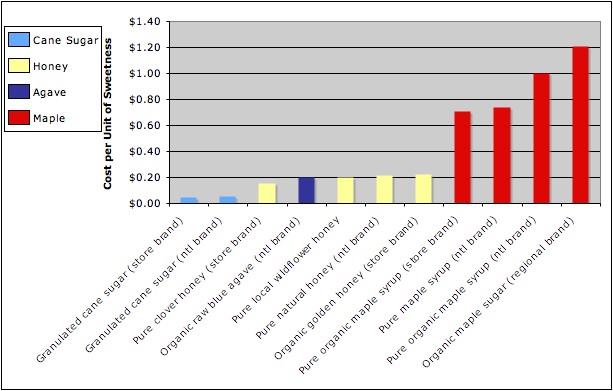
First I gathered all of my favorite natural sweeteners and entered in the costs and net weights into the spreadsheet. By dividing these two numbers, I obtained a per unit cost. Next, I compensated for their sweetness ratios by multiplying the per unit cost by how much one uses to substitute for one cup of cane sugar. For example, I use 2/3 cup honey for 1 cup of cane sugar, so I multiplied all of the honey options by 2/3.

The results are displayed graphically in the chart. No wonder people tend to use cane sugar – it’s quite inexpensive. The least expensive natural sweetener is a store brand non-organic clover honey. However, an interesting find is that local honey and organic agave, when bought in bulk, offer relatively inexpensive options, and can be cheaper than typical organic store and national brand honey. Maple sugar and syrups are the most expensive.

My verdict? I am going to buy store brand clover honey for baking since there is a cost savings and there should be no effect on the taste. In addition, I’ll look for local honey and organic agave nectar in bulk for baking and drizzling on top of foods, since they have long shelf lives and are quite tasty. I’ll save the maple for special occasions.

I look forward to hearing how you choose between different foods at the grocery store. Don’t be afraid to pull out a spreadsheet for some extra analyses. Ah, the power of spreadsheets!