Author Archives: sensitiveeconomist

Baked Acorn Squash

My sister-in-law made this great side dish for one of our festive family dinners. It was easy to make and delicious with maple syrup as the sweetener (rather than brown sugar). It is a nice alternative to sweet potatoes and can be enjoyed by carnivores and herbivores alike. Have a nice dinner!

Ingredients:
1 Acorn squash
1 Tbsp Butter
4 teaspoons Maple Syrup
Dash of Salt

Method:
1 Preheat oven to 400°F.
2 Cut the acorn squash in half, lengthwise, from stem to end. Use a spoon to scoop out the seeds and stringy stuff in the center of each half. Score the insides of each half several times with a sharp knife. Place each half in a baking pan, cut side up. Add about a 1/4 inch of water to the bottom of the baking pan so that the skins don’t burn and the squash doesn’t get dried out.
3 Coat the inside of each half with 1/2 Tbsp of butter. Add a dash of salt if you are using unsalted butter. Dribble 2 teaspoons of maple syrup to each half.
4 Bake in the oven for 1 hour 15 minutes, until the squash is very soft and the tops are browned. Do not undercook. When finished, remove from oven and let cool a little before serving. Serve as is or stir the squash with the cooked maple syrup using a fork (as shown in the picture) for easier eating.

I am sharing this recipe with Simply Sugar and Gluten Free.

Stirring and Statistics for Risotto with Sausage and Spinach

This past Friday night, I boldly stirred something I had never stirred before…risotto. Risotto is an Italian rice specialty made by stirring hot stock into a sautéed rice mixture (thanks, Epicurious, for the definition). The slow addition of hot stock allows the rice to release starch, which gives risotto a creamy consistency.

I had never before made risotto, although I found a recipe in the January 2012 edition of Cooking Light magazine that caught my eye. I made my substitutions (including adding garlic, eliminating the shallots, using homemade chicken stock, substituting the white wine with water, and finding a chicken sausage without yeast, sugar or onion) and followed the directions closely, which yielded a delightful result. However, I learned a few things about risotto that I want to share with you so you can learn from my novice mistakes:

(1) Prepare all of the ingredients ahead of time. This is because once you start stirring, you will find it hard to stop. Fortunately, I prepped fairly well ahead of time so my mushrooms were sliced, garlic was minced, sausage was diced, and other ingredients were accessible. The spinach however, remained in the bag, unwashed. As I stood stirring at the stovetop, watching with amazement as the rice slowly became a creamy risotto, it became clear that the leafy green vegetable was not going to wash itself. I felt relief when SensitiveHusband walked in the door, home from work. I was so happy that he was home so we could chat, enjoy a good meal, and he could wash the spinach.

(2) When the recipe calls for “constant stirring,” it is not kidding. Pull up a chair, hold a good book in one hand, and keep stirring with the other hand. I was able to take mini-breaks, but once you wipe the sweat from your brow, return to stirring.

I found a few other good tips from Susan Russo for NPR, but as long as you follow this recipe you should not have any trouble getting the correct result.

While I was stirring, I had some time to think, and my thoughts drifted to rice production. So after dinner I did some research. Most risottos are made with arborio rice, which is mostly cultivated in Italy. The U.S. is a net exporter of rice, growing mostly long- and short-grain varieties. About 99% of the total U.S. rice crop is produced in four regions:
1. Arkansas Grand Prairie (Arkansas is the largest single rice producing state with about 45% of rice producing acreage);
2. Mississippi Delta (includes Arkansas, Mississippi, Missouri and Louisiana);
3. Gulf Coast (Texas and Southwest Louisiana); and
4. Sacramento Valley of California.

The USDA’s rice outlook from February 10, 2012 notes that the 2011-12 global rice production forecast was raised 1.3 million tons to 462.7 million tons, which is the largest crop on record. It looks like Italy’s arborio rice crop is expected to be a good one this year, so enjoy your risotto!

Ingredients
* 3 cups (homemade or) fat-free, lower-sodium chicken broth
* 1 1/3 cups water
* 1 tablespoon extra-virgin olive oil
* 1/8 teaspoon salt
* 1 (8-ounce) package sliced mushrooms
* 5 ounces sweet Italian sausage, casings removed and diced (about 2 links)
* 5 garlic cloves, minced
* 1 cup uncooked arborio rice
* 1 (6-ounce) package baby spinach
* 1/4 cup (1 ounce) shaved fresh Romano or Parmesan cheese

Preparation
1. Bring broth and 1 cup water to a simmer in a small saucepan (do not boil); keep warm over low heat.
2. Heat a Dutch oven over medium-high heat. Add oil; swirl to coat. Add salt and mushrooms to pan; cook for 8 minutes or until browned, stirring occasionally. Remove mushrooms from pan, and set aside.
3. Add sausage to pan, and cook for 3 minutes or until browned. Add garlic; cook 1 minute, stirring constantly. Reduce heat to medium. Add rice; cook for 1 minute, stirring constantly. Stir in 1/3 cup water, and cook until liquid is nearly absorbed, scraping pan to loosen browned bits.
4. Stir in 1 cup broth mixture; cook for 2 minutes or until liquid is nearly absorbed, stirring constantly. Add remaining broth mixture, 1/2 cup at a time, stirring constantly until each portion of broth mixture is absorbed before adding the next (about 30 minutes total). Remove pan from heat. Add mushrooms and spinach; stir until spinach wilts. Top evenly with cheese. Serve and enjoy immediately.

I am sharing this recipe with Simply Sugar and Gluten Free, Miz Helen’s Country Cottage, Food Trip Friday, Cybele Pascal Allergen-Free Cuisine and Simple Living with Diane Balch.

Steak Tips with Mushroom Sauce

The grocery store recently had grass-fed steak tips on sale, and they looked quite fresh so I picked some up for dinner. When I got home I searched the Internet for some inspiration and found a recipe for steak with mushroom sauce. I had some frozen beef broth that I had made (yeast and sugar free) and made a few other changes to remove the onion. SensitiveHusband and I were really happy with the result. It was great enjoying a homemade sauce with our steak! Our sides included brown rice and roasted Brussels sprouts with grapes. We had a great meal.

Ingredients
1 pound sirloin tips
1 cup beef broth (homemade is my favorite)
8 oz mushroom caps, sliced
3 tbs butter
2 cloves garlic, chopped
1/2 teaspoon dried thyme
1/4 teaspoon salt, or to taste
1/2 teaspoon ground black pepper, or to taste
2 tablespoons all-purpose flour

Directions
Preheat an outdoor grill for medium-high heat. 

Melt butter in a large skillet over medium-high heat. Add mushrooms and cook about 5 minutes. Deglaze the pan with half of the beef broth. Increase heat and bring to a boil. Allow the mixture to boil until it has reduced by 1/3.

Meanwhile, grill the sirloin tips to desired doneness. Season with salt and pepper if desired.

When the sauce is reduced, stir in the other half of beef broth, and garlic. Return to a boil, and continue to cook for another 5 to 10 minutes. Sauce will be thin like au jus. Whisk in flour, and cook until the sauce is the desired thickness. Taste and adjust seasoning if necessary. Serve tips with mushroom sauce.

This recipe is being shared with Simply Sugar and Gluten Free, Food Trip Friday, Miz Helen’s Country Cottage and Cybele Pascal Allergen-Free Cuisine.

The First SensitiveEconomist Cookie Price Index

I am sometimes asked to name my favorite economic indicator. Don’t get me wrong – this does not come up in conversation all that often, although sometimes when a group of economists get together they talk about these things. I am not sure that I could pick my absolute favorite indicator although I am partial to the Consumer Price Index (CPI). Why? Well, the CPI measures the change over time in the prices paid for a “typical” group of goods and services. The CPI is a signal of inflation in the economy and is used for adjusting dollar values and cost of living calculations (including Social Security benefits).

In order to calculate the CPI, the U.S. Bureau of Labor Statistics surveys thousands of households across the country regarding how much they pay for items including food and beverages, housing, apparel, transportation, medical care, recreation, education and communication. It’s a good way to get a general sense of inflation, however I decided that it was time to add a SensitiveEconomist touch and create my own price index based on common ingredients that I purchase for my favorite foods.

I found inspiration from my favorite chocolate chip cookie recipe, and used its ingredients to create the price index. Here is how it works (the methodology): I looked for the lowest prices for each ingredient on Amazon.com (except for the local honey, because by definition I buy it locally). Then I calculated how much of each ingredient I use in one batch and multiplied that ratio by the total price I paid for the entire container. Summing up the prices per batch of all the ingredients results in how much it costs me to bake one batch of cookies. Over time I can check the prices and see if the price per batch rises or falls. To see my calculations, view my excel file: Price Index 2012-Feb

The first Cookie Price Index shows that it costs $13.37 to bake one batch of these fabulous, delicious chocolate chip delights (about 32 cookies)! That’s less expensive than buying cookies from a bakery or specialty shop. It will be interesting to see how this tracks over time and if it corresponds at all with the federally-published price indices.

Leslie and Rick’s Homemade Yogurt

Leslie and Rick have been enjoying their own (no sugar) yogurt for awhile, and they were kind enough to share their recipe as today’s blog contributors.

We’ve been making our own yogurt. All you need is milk (fat free, 1-2% or whole- your preference) and a high quality plain yogurt containing acidophilus & bifidus cultures (Stonyfield or Liberte work well). Basically, you need to heat the milk to 185 degrees fahrenheit, cool it down to 110 degrees and add starter yogurt (a soup spoon works well).

Our technique makes the process very simple. We use a one quart ball mason jar filled with about three cups of milk. Place the jar in a medium sauce pan filled with water. Heat on high. It should only take about 5 minutes after the water boils for the milk temp to reach 185. Maintain the 185 for at least one minute. Using a candy thermometer as a spoon eliminates the need for an extra utensil since it’s in the jar anyway.

Remove the jar from the pan. Pour out the hot water and replace with cold water. Set the jar back in the pan until the temp drops to 110. Stir the 2 blobs of yogurt in well, put a lid on the jar, wrap it in a kitchen towel and let it sit in a warm place (like near a radiator), for 10 hours. If there’s a little water on top of your yogurt, pour it off before refrigerating. This yogurt is a bit thinner in consistency than you may be used to, but that’s because there are no artificial thickeners.

Make sure you leave enough of your home made yogurt in the jar to act as the starter for your next batch. Enjoy.

This recipe is shared with Simply Sugar and Gluten Free, Miz Helen’s Country Cottage, Food Trip Friday, Cybele Pascal Allergen-Free Cuisine and Sweet as Sugar Cookies.

One-Bowl Chocolate Agave Cake with Agave Whipped Cream

Have you ever just been in the mood for a piece of cake? And you look around the kitchen in search for a delectable dessert only to come up empty-handed? This happened to me a few weeks ago, but fortunately it was the weekend and I had a spare hour. So I searched the internet and found a recipe for a one-bowl chocolate cake. The name sounded promising, for fewer bowls used would equal fewer bowls to clean up later on. The recipe also showed promise because the ingredients were all things that I normally have in my cupboards. I halved the recipe to just make one round pan instead of a more complicated layer cake, swapped the flour for the whole wheat version, and used agave instead of sugar. While the cake baked I searched the internet for a frosting. Whipped cream sounded good to me, especially because it only required three ingredients.
It turns out that I did have a cake in my kitchen. All of the ingredients were there, it just took a little bit of creativity and some mixing to make the cake a reality. Within an hour SensitiveHusband and I were able to enjoy this great dessert.

One Bowl Chocolate Cake
Ingredients:
2/3 cup agave nectar
1 cup whole wheat flour
1/3 cup unsweetened cocoa powder
3/4 teaspoon baking powder
3/4 teaspoon baking soda
1/2 teaspoon salt
1 egg
1/2 cup milk
1/4 cup vegetable oil
1 teaspoon vanilla extract
1/2 cup boiling water

Preparation:
Preheat oven to 350 degrees F. Grease and flour one nine-inch round pan.

In a large bowl, stir together the flour, cocoa, baking powder, baking soda and salt. Add the agave nectar, egg, milk, oil and vanilla. Mix for 2 minutes on medium speed of mixer. Stir in the boiling water last. Pour into the prepared pan.

Bake 30 to 35 minutes in the preheated oven, until the cake tests done with a toothpick. Cool in the pan for 10 minutes, then remove to a wire rack to cool completely.

Whipped Cream Topping
Ingredients:
1 cup heavy cream
1/8 cup agave nectar
1 teaspoon vanilla

Preparation:
Whip cream until almost stiff. Add agave and vanilla; beat until cream holds peaks. Spread over top of cooled chocolate cake or another dessert. Top the whipped cream with grain-sweetened chocolate chips if desired.

I am sharing this recipe with Simply Sugar and Gluten Free, Miz Helen’s Country Cottage, Food Trip Friday, Cybele Pascal Allergen-Free Cuisine and Sweet as Sugar Cookies.

The VegFest and Recipe Request

Greetings! Back in November I interviewed the founder of Wholesome Creations and mentioned that she was also organizing a healthy living festival. Well, the details are out and I want to share them with you! The Connecticut Vegetarian and Healthy Living Festival is taking place at the Connecticut Convention Center from April 28-29, 2012. It will bring together people who want to live a healthy lifestyle with exhibitors and professionals who can help them achieve their goals. Whether you live in the area or not, there are ways in which you can participate. Below are a few ideas:

1. Save the Date! The festival will be held at the Connecticut Convention Center in Hartford from April 28-29, 2012. There is no entrance fee (wow!) except for a non-perishable vegan/vegetarian food item to donate to food banks and shelters. What a wonderful way to encourage event attendance and help those who rely on the generosity of others for their meals. You can stay up-to-date on the details of the event by visiting the web site, ctvegfest.org, following @ctvegfest on twitter, and joining the CT VegFest group on Facebook.

2. Participate! The CTVegFest is looking for people who are willing to volunteer – a little bit or a lot – to help make this event a success. Fill out the volunteer form on the web site to explore your options, or join the meeting on February 8, 6pm, at the Holiday Inn Express on Brainard Road in Hartford.

3. Share Recipes that are Great! A vegan (no animal-derived ingredients used) cookbook is being produced as a fundraiser for the festival, and we have been asked for our favorite recipes to be included. You can submit your dish online – I just shared a recipe for Golden Raisin and Apple Stuffing.

The CTVegFest is shaping up to be a great event. As more information becomes available I’ll share it, and I hope to see you there!

You Will Make These Popovers Over and Over

Popovers, light and hollow rolls made from an egg batter, are a yeast-free, sugar-free treat. Popovers are an American recipe that are thought to have descended from English batter puddings and Yorkshire puddings, although the origin is a bit uncertain. Puddings in medieval times were not like today’s custard-like desserts, but rather were meat-based.

According to Food Timeline, “17th century English puddings were either savory (meat-based) or sweet (flour, nuts & sugar) and were typically boiled in special pudding bags.” In the 1840s, as Americans found that they did not need to boil traditional puddings to feed their families because there was enough of a food supply, Alfred Bird introduced custard powder as an alternative to thickeners made from eggs. “It wasn’t long before Americans began using custard powder and other cornstarch derivatives as thickeners for custard-type desserts. This proved quite useful for overlander (conestoga wagon) cooks who did not have ready access to a reliable supply of fresh eggs.”

However, Chef James Beard claimed that the American popover was not derived from the English Yorkshire pudding – so it’s up to you to decide the popover’s origin; perhaps you can create a new recipe and make it your own classic.

Thanks, Bree, for making these delicious popovers for our dinner celebration!

One word of caution from the cook – a popover tin will provide the best results; using a muffin tin may cause disappointment to you and others at your dinner table.

Popovers (Adapted from Martha Stewart): Makes 12
2 1/2 c milk
2 1/2 c all purpose flour
Pinch salt
6 whole lg eggs
2 lg egg yolks
1/4 c very soft butter

Heat oven 425 degrees. Whisk milk, flour, salt until just incorporated. Will be lumpy.

Beat in eggs and yolks one at a time, until just incorporated. Do not over mix. Will be lumpy.

Brush inside of popover tins with generous amount of butter. Divide batter evenly among tins. Bake 20 minutes. Reduce temperature to 350; bake until puffed and golden brown, 15-20 minutes more. Serve immediately.

I am sharing this recipe with Simply Sugar and Gluten Free, Miz Helen’s Country Cottage, Food Trip Friday and Cybele Pascal Allergen-Free Cuisine.

Baked Cornish Game Hens: A Fun Dinner Option

I like serving Cornish game hens when I am looking for something festive that does not require roasting an entire chicken or turkey. They don’t take too long to prepare and are really tasty, therefore good for celebration meals as well as any dinner. Cornish game hens have a lot of nutrients and are good sources of some B vitamins, phosphorous, zinc and riboflavin, among others.

SensitiveHusband and I prepared these on New Year’s Eve, diverging from the original recipe by reducing the butter and swapping the onion with a carrot. We also used thyme instead of oregano. Serve with any of your favorite starch and vegetable – we had couscous and roasted brussels sprouts.

Ingredients:
2 Cornish game hens
1/3 cup melted butter, divided
1/2 stalk celery, chopped
1 carrot, chopped
12 button mushrooms, chopped
2 cloves garlic, minced
1 tablespoon dried basil
1 teaspoon dried thyme
1 tablespoon chopped fresh parsley

Preparation:
–Preheat oven to 325 degrees F.
–In a small bowl combine 1/4 cup melted butter, celery, carrot, mushrooms, garlic, basil, thyme and parsley.
–Season hens inside and out with salt and pepper to taste, then stuff with equal amounts butter/vegetable mixture. Place stuffed birds in a 9×13 inch baking dish, breast side up. Drizzle with 1/4 cup melted butter and sprinkle with parsley.
–Cover dish with aluminum foil and bake in the preheated oven for 1 1/2 hours. Remove cover and brown at 500 degrees F.

I am sharing my recipe with Simply Sugar and Gluten Free and Food Trip Friday.

Spinach Gratin and Green Beans Almondine

And now…the remaining recipes from our holiday menu! These two dishes are great to bring to others’ houses. I know this first-hand because these vegetables were brought to our house and they worked so well with the rest of the meal. They are easy to prepare too!

The first is Spinach Gratin, which my sister-in-law brought. It is from Ina Garten’s Barefoot Contessa Parties cookbook.  She made a change to accommodate my food sensitivities (replacing the onions with garlic) and tweaked the recipe further for a little boost in nutrition (using whole wheat flour, lighter cream, and less salt). The ingredients and preparation follow.
 
1/2 stick unsalted butter
3 cloves of garlic, chopped
1/4 cup whole wheat flour
1/4 teaspoon nutmeg
1 cup light cream
2 cups milk
5 10-ounce boxes of frozen chopped spinach, defrosted
1 cup freshly grated parmesan cheese
1 teaspoon kosher salt
1/2 teaspoon freshly ground black pepper
1/2 cup grated Gruyere cheese
 
Preheat oven to 425.  Melt butter over medium heat – add garlic.  Add flour and nutmeg and stir for 2 minutes. Next add cream and milk – cook until thickened. After squeezing away liquid from defrosted spinach, add to pan.  Put in 1/2 parmesan cheese in the mix, and season with salt and pepper.
 
Put entire mixture into a baking dish, and add 1/2 cup parmesan and 1/2 cup Gruyere to top. Bake for 20 minutes. Delicious!

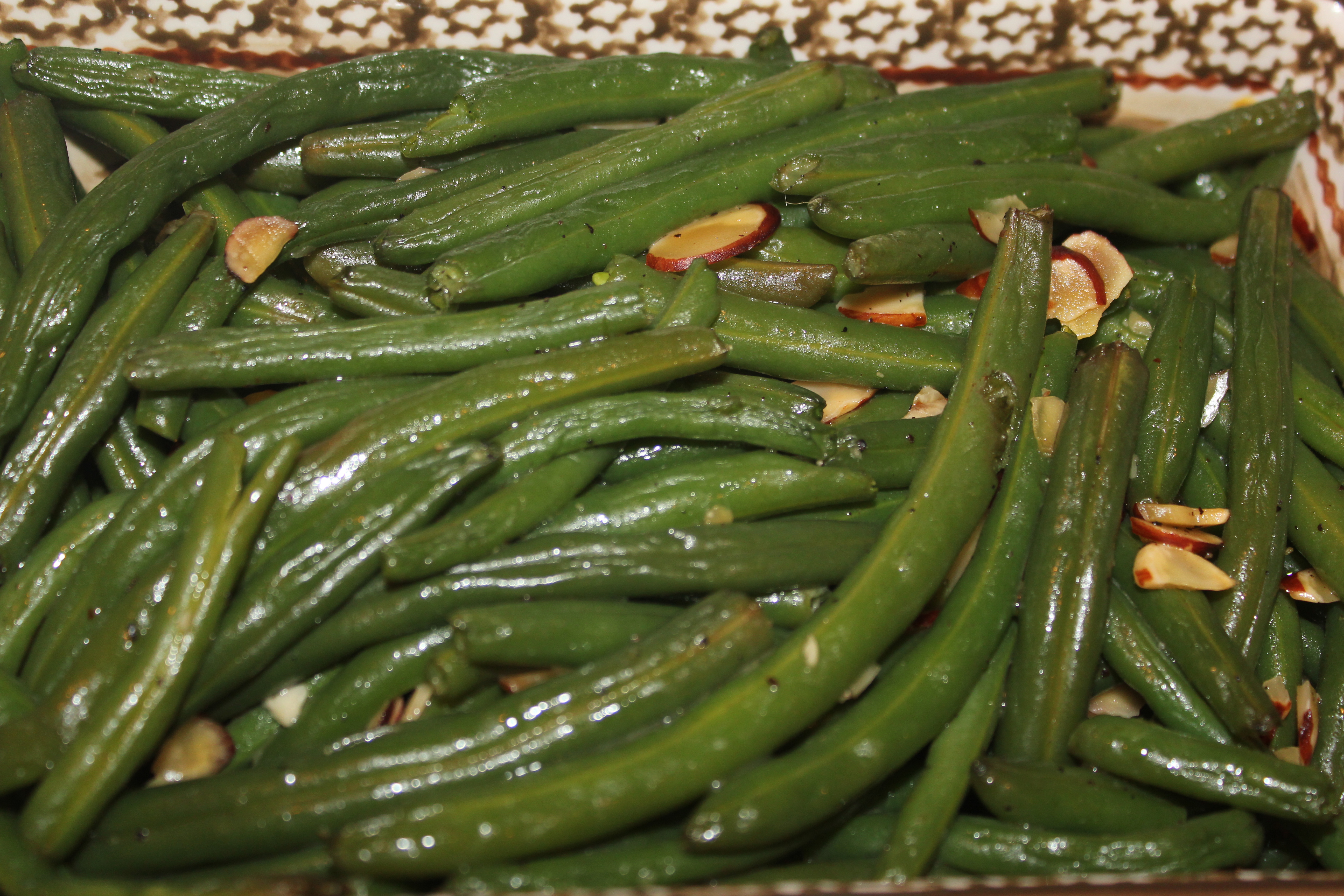
My mother-in-law also brought this dish of Green Beans Almondine. I just love green beans – especially in this classic dish. They make fabulous leftovers too. Here is the recipe:

1 lb green beans
2 tablespoons slivered almonds
2 tablespoons butter
1 teaspoon lemon juice

Cook green beans by either steaming or covered in a small amount of boiling salted water until crisp-tender. Drain. Cook almonds in butter over low heat, stirring occasionally, until golden. Remove from heat and add juice. Pour over beans.

Enjoy these great recipes; and here is to happy holiday meals together.

Aim sharing this recipe with Simply Sugar and Gluten Free and Food Trip Friday.